Showing posts with label Ries Ferdinand. Show all posts

RIES Piano Concertos Nos. 2 and 9, Rondeau brillant, Volume 5

“Hinterhuber runs Ries’s technical obstacle course with ease, delivering these pieces with all the dash they deserve. And Uwe Grodd prods his New Zealanders to rise above Ries’s rather pedestrian orchestral tuttis and accompaniments. Obviously, this is a must-have for completists who have collected the first four volumes in this Ries survey. It’s also recommended to those who enjoy early romantic virtuoso piano works from the period…” --Fanfare, May 2013

“Despite his admiration for Beethoven, Ries seems closer to Hummel in these elegantly turned out Concertos. Hinterhuber and Grodd are engaging advocates.” --BBC Music Magazine, Christmas 2012 ****


Christopher Hinterhuber (piano)

New Zealand Symphony Orchestra, Uwe Grodd

The fourteen works for piano and orchestra of Ferdinand Ries stand alongside those of Hummel as the finest and most important of their kind from the early decades of the 19th century. Intensely lyrical and yet displaying at times a rugged Beethovenian grandeur, Ries’s eight concertos are works of impressive musical stature. In this fifth and final recording we encounter the first and last of his published concertos and the virtuosic Rondeau brillant, Op. 144. “Sparkling performances… the recording is first rate.” (Penguin Guide on Vol. 3, 8570440).

“Grodd offers...an imposing exposition, taken up by Hinterhuber who is equally aware of its quality. 'Skilful industry' wasn't Ries's only attribute.” --Gramophone Magazine, January 2013

RIES Concert Overtures


This is a lovely program of exciting, colorful music. Ferdinand Ries may not have been a great composer in large forms, such as symphonies and concertos, but these single-movement pieces give him the opportunity to use his imagination, and he takes full advantage. The Ouverture bardique, for example, asks for six harps (though it sounds more like two here, since there are only two individual parts), and employs a Welsh folk theme. Both The Bride of Messina and Don Carlos (plays by Schiller) are suitably dramatic, and full of fire. 


Ries loads his Victory March with brass and percussion, but the music's high kick is buoyant rather than pompous. The dramatic overture "L'Apparition" was Ries' final orchestral work, and it seems to foretell the Mendelssohn of A Midsummer Night's Dream.

Howard Griffiths and the Cologne radio orchestra play the music with plenty of spirit. The solo woodwinds, which Ries employs with particular gusto, have lots of character. Timpani use hard sticks, and the strings offer a lean sound that mellows expressively in lyrical passages. The style, with biting, edgy brass, is obviously "period performance"-influenced, but not absurdly so. In short, the performances are stylish and sound idiomatic. As usual with German radio engineering, the sonics are very good, with excellent balances between orchestral sections. This disc makes the perfect introduction to a composer who has more to offer than the fact that he was Beethoven's pal.

--David Hurwitz, ClassicsToday.com

RIES Piano Concertos Nos. 4 and 5, "Pastoral", Volume 4


“[The Introduction and Rondeau Brillant is] a real virtuoso vehicle, to whose demands Hinterhuber rises - as in the concertos - with what seems like effortless ease and affection...If you've yet to make this composer's acquaintance, this is an excellent place to start.” --International Record Review, January 2011

“Christopher Hinterhuber sounds very comfortable in this music; his playing has sufficient sparkle, and he tempers his virtuosity with good taste. The accompaniments are fine too, the sonics very good. Both [works] show Ries at his best.” --ClassicsToday.com, December 2014 


Christopher Hinterhuber (piano) - Bournemouth Symphony Orchestra, Uwe Grodd

The fourteen works for piano and orchestra of Ferdinand Ries stand alongside those of Hummel as the most important of their kind from the early decades of the 19th Century.

Intensely lyrical and yet displaying at times a rugged Beethovenian grandeur, Ries’s concertos are works of impressive musical stature.

The three works featured on this recording span the years 1809 to 1835 and include the fascinating Concerto Pastoral, Op. 120, and the Introduction et Rondeau Brillant, WoO54, composed at the end of Ries’s long and brilliant career as a pianist-composer.

Album Reviews

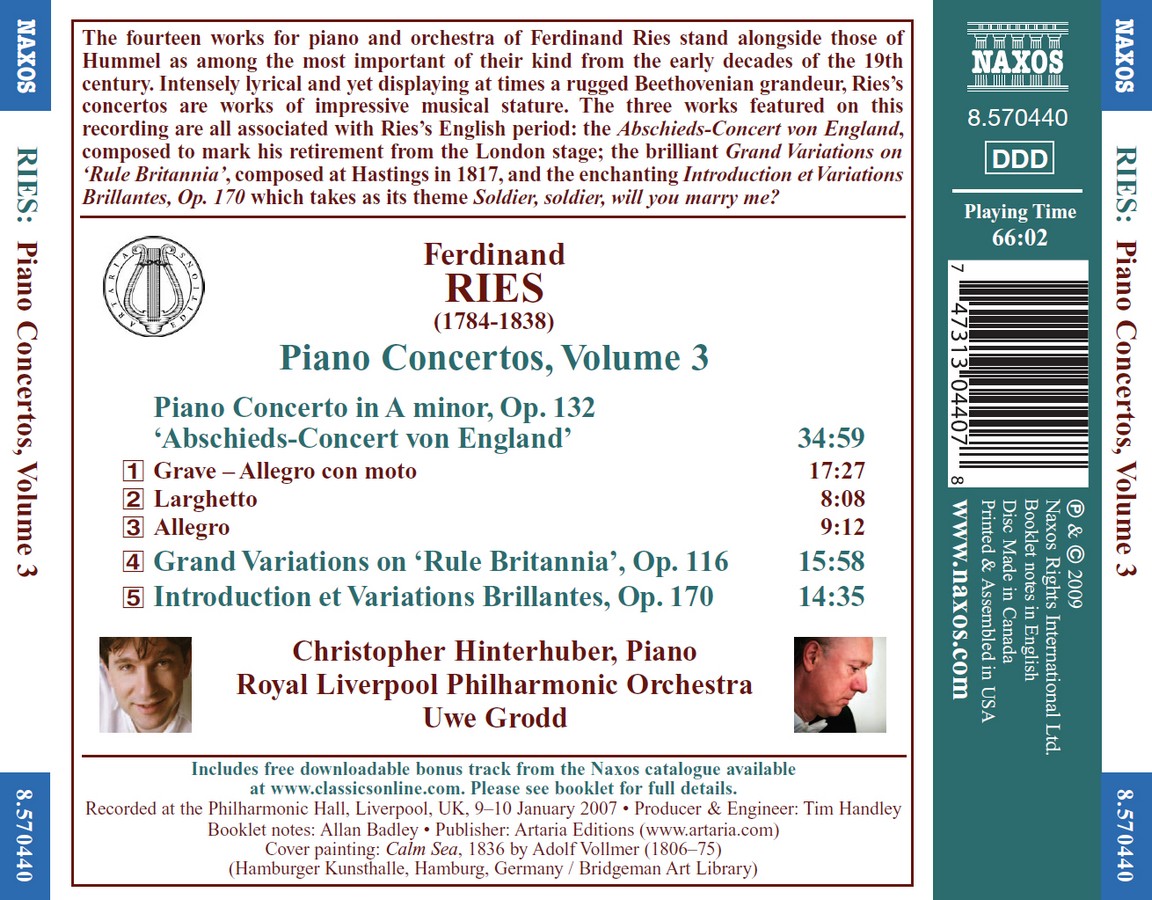
RIES Piano Concerto No. 7, Grand Variations on Rule Britannia, Etc, Volume 3


“…if you enjoy brilliant display pieces whose untroubled function is to dazzle and entertain, then Ries is your man. …the excellent Christopher Hinterhuber has his work cut out and delivers the goods in sparkling, empathetic fashion.” --Gramophone Magazine, September 2009

“it is entertaining rarities like these that make record collecting so much fun...Sparkling performances to match the music, and the recording is first rate.” --Penguin Guide, 2011 edition


The fourteen works for piano and orchestra of Ferdinand Ries stand alongside those of Hummel as among the most important of their kind from the early decades of the 19th century. Intensely lyrical and yet displaying at times a rugged Beethovenian grandeur, Ries’s concertos are works of impressive musical stature.

The three works featured on this recording are all associated with Ries’s English period: the Abschieds-Concert von England, composed to mark his retirement from the London stage; the brilliant Grand Variations on ‘Rule Britannia’, composed at Hastings in 1817, and the enchanting Introduction et Variations Brillantes, Op. 170 which takes as its theme Soldier, soldier, will you marry me?

Album Reviews

RIES Piano Concerto No. 3, Introduction and Polonaise, Etc, Volume 2


As one of the greatest pianists in Europe of his time and a composer of exceptional ability, it is surprising that the name Ferdinand Ries is not better known today. His eight piano concertos stand alongside those of Hummel as the most important works of their kind from the early 19th century. Intensely lyrical and yet displaying at times a rugged Beethovenian power, Ries’s concertos are works of impressive musical stature. The Piano Concerto in C sharp minor, composed in Russia in 1812, is a striking work full of spirit and boundless invention. Its companion pieces are no less remarkable in their brilliant juxtapositions of dazzling virtuoso display and passages of exceptional lyrical beauty.
Release date: 09/2007


This is the second volume in the Naxos Ries series devoted to his Piano Concertos. It’s proving to be a rather beguiling stroll through eclectic pathways, incomparably aided by some devoted, first class performances and recordings. As before the soloist is Christopher Hinterhuber, though this time the New Zealand Symphony Orchestra has been replaced by the Gävle Symphony Orchestra. The conductor remains Uwe Grodd.

Album Reviews

RIES Piano Concertos Nos. 6 and 8 "Salut au Rhin", Volume 1


“spirited playing of neglected but delightful concertos” --Gramophone Magazine

“An hour of sheer delight here. Ferdinand Ries is probably best known for his associations with Beethoven. Here is an opportunity to hear how he sounds on his own two compositional feet in two world premiere recordings….An excellent disc. One of the beauties of Naxos is that one can experiment with rare repertoire at low cost. Here that cost is certainly justified” --MusicWeb International


The eight piano concertos of Beethoven’s friend and pupil Ferdinand Ries stand alongside those of Hummel as the most important works of their kind from the early 19th Century. Intensely lyrical and yet displaying at times a rugged Beethovenian power, Ries’s concertos are works of impressive musical stature.

This world première recording features the Concerto in C major composed in 1806 shortly after Ries completed his studies in Vienna with Beethoven, and the majestic Concerto in A flat ‘Gruss an den Rhein’, written twenty years later on his return to the Rhineland, which looks forward to the piano writing of Chopin.

Album Reviews