Showing posts with label 20th century. Show all posts

DVOŘÁK, SHOSTAKOVICH & TOWER Piano Trios


Founded in 1982 by distinguished faculty members at the Oberlin Conservatory of Music, the Oberlin Trio has performed to enthusiastic acclaim throughout the world for more than 30 years. Since 2008, the tradition has been carried forward by pianist Haewon Song, violinist David Bowlin, and cellist Amir Eldan. Together, they have presented recitals and master classes across the United States, Korea, and China. In keeping with the ensembles commitment to educating young artists, members of the Oberlin Trio enjoy teaching at top music schools in the U.S. and abroad. 
Release date: 8th Jan 2016

TANGOS & FANTASIES


The new release from one of Armenia’s leading and most popular music groups. Following their prior success this year with their first release of Expressia—Armenian Fantasy, Cadence Ensemble expand their recording ventures to Expressia—Tangos and Fantasies.

This new release explores the tango at its best including works from some of the great Tango writers including Astor Piazzolla and fellow Armenian Narine Zarifian. With innovative arrangements of works by Carlos Gardel, Hector Stampioni and the Fantasy on Themes of Porgy and Bess by George Gershwin.


Astor Piazzolla (1921-1992) was an Argentine tango composer and bandoneon player who revolutionised the traditional tango into a new style, incorporating elements from jazz and classical music, termed nuevo tango. He is widely considered the most important tango composer of the latter half of the 20th century. A formidable bandoneonist, Piazzolla continuously performed his own compositions with different ensembles. He is known in his native land as “El Gran Ástor” (The Great Astor).

Carlos Gardel (1887-1935) was perhaps the most prominent figure in the history of tango. He died in an airplane crash at the height of his career, creating the image of a tragic hero throughout Latin America. For many, Gardel embodies the soul of the tango style that sprang from the barrios of Buenos Aires and Montevideo at the end of the 19th century.

Born in 1958 in Yerevan, Armenia, Narine Zarifian graduated from Yerevan State Conservatory in 1984, where she now holds a professorship. A member of Armenia’s Union of Composers and the International Association of Female Composers, she has performed in Greece, the Czech Republic, Syria, Lebanon and Russia. Narine’s works include a ballet, a symphonic poem, a set of vocal works, string quintets, a set of symphonic and folk works for symphonic orchestra, folk and electronic instruments and a concerto for guitar.

The pianist, composer and arranger Hector Stampioni (1916-1997) is often described as a master of tango who embodied the fundamental values of this musical form from the 1940s to the present day. A brilliant orchestator, exquisite pianist and outstanding composer, Stampioni is one of the undisputed titans of the tango movement.

George Gershwin (1898-1937) wrote most of his vocal and theatrical works in collaboration with his elder brother, lyricist Ira Gershwin, composing for both Broadway and the classical concert hall. He also wrote popular songs and many of his compositions have been used on television and in numerous films. George Gershwin’s chief works include Rhapsody in blue, An American in Paris, Porgy and Bess and Second Rhapsody.

SHOSTAKOVICH Chamber Symphonies (arr. Rudolf Barshai)

“The Dmitri Ensemble…[show] evident discipline and commitment…[they] succeed in making Barshai’s scored version sound alert rather than listless.” --BBC Music Magazine, June 2015 ****

“Shostakovich’s music and Rudolf Barshai’s very understanding re-imagining of it is expertly served in these superb performances, both in the technical sense and emotionally … Graham Ross and his expert colleagues make a wonderful case for these works and their outstanding performances have been captured in very fine recorded sound, produced and engineered by John Rutter.” --MusicWeb International, 18th August 2015


The Dmitri Ensemble, Graham Ross

The Dmitri Ensemble under Graham Ross performs Shostakovich's String Quartets Nos. 1, 8 and 10, re-worked as thrilling Chamber Symphonies for string orchestra by his pupil and advocate, Rudolf Barshai. Written in Dresden 1960,

Shostakovich was sent there to compose a film score but was overwhelmed by the aftermath of WWII bombings which he saw; the result was the 8th quartet.

Named after Dmitri Shostakovich, the Dmitri Ensemble is based around the central core of a string ensemble, with a special commitment to presenting both unjustly neglected and newly-penned works with an innovative approach to engaging concert programming. Under the direction of the co-founder and Principal Conductor, Graham Ross, it has worked alongside living composers and has an increasingly diverse discography.

The Ensemble’s collaborations with the Choir of Clare College, Cambridge, for hm USA, include a highly-praised recording of choral works by Imogen Holst, which received both Diapason d’Or and Le Choix de France Musique awards, and which was shortlisted for a 2013 Gramophone Award and 'Lux de caelo: Music for Christmas', released in 2014, was widely praised in the national and international press, selected as Christmas Choice, BBC Music Magazine, 2014. Their latest release in a series of works for the church year, which have regularly made the Top 10 of the UK Specialist Classical Charts, is 'Ascendit Deus: Music for Ascensiontide and Pentecost' with the Choir of Clare College, released March 9th.

“The rendition as a whole is nothing if not fresh and finely poised, the band’s relatively modest forces placed in generous acoustic (St John the Evangelist, Upper Norwood) without loss of clarity or focus. Indeed, the results are superb … Recommended.” --Gramophone Magazine, May 2015

FERNANDES Violin Concerto


Armando José Fernandes was one of the most important composers of 20-th century Portugal. He was an integral member of the ‘Grupo dos Quatro’ – alongside Jorge Croner de Vasconcelos, Fernando Lopes-Graça and Pedro do Prado – which exerted substantial influential over Portuguese music in the mid-1900s. His musical language, based on an extended tonality, is influenced by Ravel and Debussy, with occasional hints of expressionism and even a touch of moody Shostakovich. Nevertheless there is a southern vitality in the basically romantic heart of this fascinating composer, whose works we hear for the first time on CD.


Violinist Carlos Damas made his solo debut aged just 15 with the Portuguese National Broadcasting Radio Symphony Orchestra. His successful career brought him all over the world, and his recordings won universal praise. Among his more recent achievements is the release of an hugely successful CD featuring the works of Fritz Kreisler, which has been praised by The Strad as one of the best Kreisler discs on the market.

BACEVIČIUS Piano Concertos Nos. 3 and 4, Spring Suite


"…Performances and recording quality are first-rate. Lyndon-Gee gave us…revelatory recordings of the music of Igor Markevitch and the symphonies of George Rochberg. His detailed, understanding approach pays similar dividends here, while the Lithuanian National Symphony Orchestra shines in the service of its under-appreciated countryman. Pianist Gabrielius Alekna…brings both pinpoint accuracy…and sensitivity to piano parts that are undoubtedly trickier to negotiate than they sound. " --Fanfare, November 2015

"Both pianist and orchestra serve the composer well as does conductor Christopher Lyndon-Gee…" --MusicWeb International, June 2015


Vytautas Bacevičius remained virtually unknown as a composer during his lifetime, in contrast to the fortunes of his sister Grażyna Bacewicz, who retained her Polish nationality. Rendered stateless by the outbreak of World War II while he was on tour as a concert pianist in Argentina, he eventually settled in New York until his death in 1970, giving acclaimed piano recitals, teaching, and writing astoundingly original orchestral scores. He never lost his deep allegiance to and nostalgia for Lithuania. This recording gives an eloquent introduction to his pianistic virtuosity and to his mystical, Scriabinesque vision of the orchestra.

Album Reviews

PROKOFIEV Symphony No. 3, Scythian Suite, Autumnal Sketch


"[Marin Alsop] gets unfailingly good string‑playing, often more sensitively nuanced than that of her rivals…" --Gramophone, June 2015

"Alsop and the São Paulo Symphony Orchestra deliver the Third and the Scythian Suite with powerful, incisive rhythms and volatile dynamics, which makes for exciting listening, while their performance of Autumn offers smoother gradations of textures and a gentler feeling. Naxos provides adequate reproduction with good details and clear textures…" --Allmusic.com, May 2015 Editors' Choice


São Paulo Symphony Orchestra, Marin Alsop

This fourth volume in Marin Alsop’s acclaimed Prokofiev symphonic cycle features two of his most viscerally exciting works. Using material salvaged from his opera The Fiery Angel, the Third Symphony was hailed by Serge Koussevitzky at its 1929 première as ‘the best symphony since Tchaikovsky’s Sixth’. Originally commissioned as a ballet by Sergey Dyagilev but rejected as un-danceable, the Scythian Suite has become a popular orchestral showpiece, while Prokofiev retained a lifelong fondness for his dark-hued early symphonic sketch Autumn.

Judging by the response to the previous volumes of this fruitful partnership with Marin Alsop and the excellent São Paulo Symphony Orchestra this new release will have no problems in becoming a market leader. The First and Second Symphonies disc (8573353) was an Allmusic.com ‘Editor’s Choice’ for its “first-rate performance”, and the Fifth Symphony was described as “an outstanding achievement” by BBC Music Magazine, which also regarded the Fourth Symphony (8.573186) as “compelling”. The Blu-ray releases have also been widely acclaimed, with NBD0031 made Audiophile Audition ‘Best Disc of the Year’ in 2012, and prompting BBC Music Magazine to write, “this exceptional account of Prokofiev’s Fifth Symphony is partnered by a revelatory performance of The Year 1941, while the recording bursts out of the speakers.”

WALTON Symphony No. 1 & Violin Concerto


“Gardner brings out all the harmonic tension in the music...in a reading which never loses momentum, even when Gardner reins back the pace to capture the aching passion of the slower episodes. There’s explosive energy a-plenty and no lack of dynamism...This is a compelling coupling of exceptionally fine Walton performances...Both these performances now become the modern benchmark for the respective works.” --MusicWeb International, 16th May 2014

Gramophone Magazine Disc of the Month - July 2014


“Gardner presides over blisteringly eloquent and splendidly unbuttoned accounts of both these Walton masterworks...Heaps to savour and cherish, in sum; certainly, seasoned Waltonians will have a ball. With magnificent truthful sound and judicious balance throughout, this terrific coupling should be snapped up without delay.” --Gramophone Magazine, July 2014

“Little's way with the virtuoso passages is a notch less headlong than [on her earlier recording], allowing the ear to savour her phenomenal accuracy, yet with no loss of fire...Gardner and the BBC SO provide an accompaniment whose range of detail..is never driven too hard...a masterclass in how to generate formidable dramatic voltage while keeping the music's eruptive energy on a tight rein.” --BBC Music Magazine, June 2014 *****

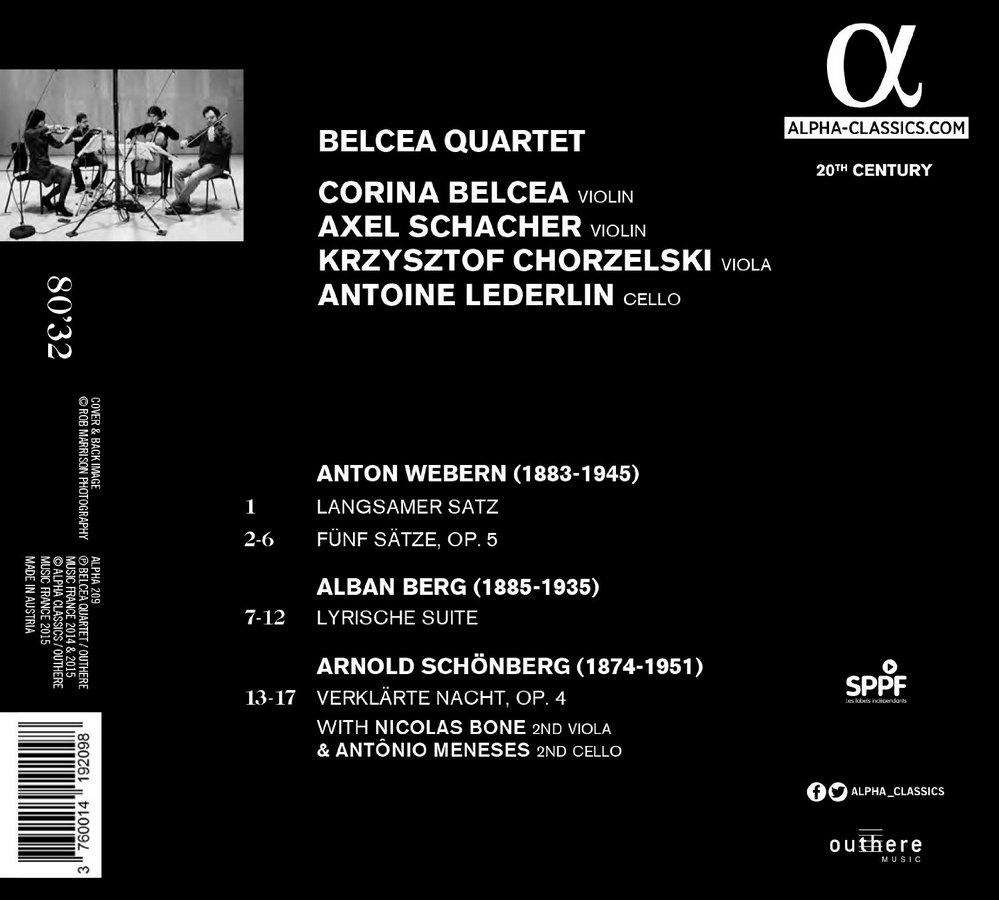
BERG, WEBERN & SCHÖENBERG Chamber Music


“the Belceas' muted, breathless approach is no less effective than the extrovert technical accomplishment and timbral extremes of the LaSalle Quartet…their Verklärte Nacht bucks the trend of recent slow and solemn performances…and is fitted closely to Dehmel's lascivious storyline.” --Gramophone Magazine, October 2015

“The Belcea Quartet, plus Nicolas Bone (violin) and Antonio Meneses (cello), play passionately and precisely.” --Sunday Times, 2nd November 2015


With a complete recording of the Beethoven quartets that caused a stir and enchanted concert halls everywhere, the Belcea Quartet is henceforth considered one of the finest quartets in the world. ‘The principle characteristic of their playing is [...] intensity,’ wrote BBC Music Magazine in 2013.

With this new recording, the Quartet tackles another summit of chamber music: the Second Viennese School. With their passion and technical abilities, this breathtaking music, which drastically changed the history of music, rings out in all its force and mystery.

HARTMANN Concerto funebre


“Crisply and incisively argued … musicianship of the highest order” --International Record Review

“…the Concerto funebre for violin and strings has established itself as Karl Amadeus Hartmann's most familiar work…the way in which the Britten Sinfonia support and enfold their young soloist's beautifully nuanced and textured playing is a model of close-knit ensemble playing, and the natural, detailed sound picture captures all of that give and take.” --BBC Music Magazine, September 2007 ****


“It is such an obvious idea to combine Hartmann's Concerto funebre (1939, rev 1959) with the four unaccompanied works from 1927 that it's surprising that no company has thought of it before now. The Suites and Sonatas are not well known, not even being performed until the mid-1980s. Hartmann composed them while still a student with his mature style some years away, yet their muscularity, contrapuntal and harmonic élan and the sense of self-belief they exude show them to be products of a for- midable, free-thinking creator. Ibragimova proves an ideal exponent, her tempi free and elastic (and mostly quite quick). Her fluency and flexibility pay great dividends time and again, as in the First Suite's central Rondo or concluding Ciaconna or the Second Suite's second span, Fliessend. Hyperion's sound-picture is natural.

Ibragimova's fiercely clear-eyed account of the Concerto funebre– alive to the music's expressive demands as well as its dynamic markings – faces stiff competition but need not fear comparison with any of the dozen or so rival accounts. Her technique is formidable to say the least and if marginal preferance is for Isabelle Faust (Harmonia Mundi), Ibragimova is on her shoulder, although Hyperion's couplings and recording quality, to say nothing of the excellent Britten Sinfonia, deserve a share in the plaudits. Recommended.” --Gramophone Classical Music Guide, 2010

RACHMANINOV Piano Concerto No. 4, Corelli Variations


"Jean-Yves Thibaudet's 1994-1996 recordings of Rachmaninoff's four concertos and Paganini Rhapsody are among the finest ever made of this music, and it is surprising London didn't keep them in the catalog longer. ...Ashkenazy provides the finest accompaniment imaginable. Ashkenazy, who recorded this concerto as soloist with André Previn, Eugene Ormandy and Bernard Haitink, emphasizes rhythmic accents—trumpet statements are incisive and add much to the excitement. If you love Rachmaninoff, you should have these performances." --Classical CD Review


RACHMANINOV Piano Concertos 1 & 3


"Jean-Yves Thibaudet's 1994-1996 recordings of Rachmaninoff's four concertos and Paganini Rhapsody are among the finest ever made of this music, and it is surprising London didn't keep them in the catalog longer. ...Ashkenazy provides the finest accompaniment imaginable. Ashkenazy, who recorded this concerto as soloist with André Previn, Eugene Ormandy and Bernard Haitink, emphasizes rhythmic accents—trumpet statements are incisive and add much to the excitement. If you love Rachmaninoff, you should have these performances." --Classical CD Review


RACHMANINOV Piano Concerto No. 2, Paganini Rhapsody


"Jean-Yves Thibaudet's 1994-1996 recordings of Rachmaninoff's four concertos and Paganini Rhapsody are among the finest ever made of this music, and it is surprising London didn't keep them in the catalog longer. ...Ashkenazy provides the finest accompaniment imaginable. Ashkenazy, who recorded this concerto as soloist with André Previn, Eugene Ormandy and Bernard Haitink, emphasizes rhythmic accents—trumpet statements are incisive and add much to the excitement. If you love Rachmaninoff, you should have these performances." --Classical CD Review


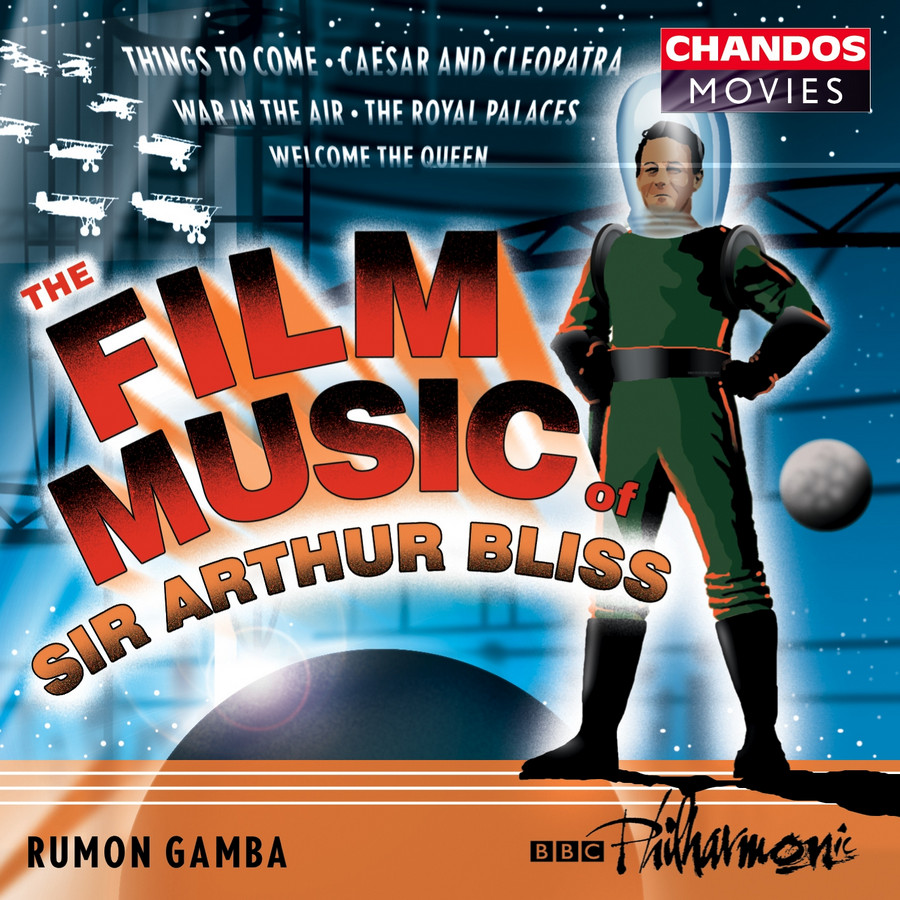
The Film Music of Sir ARTHUR BLISS


"... this splendid CD confirms Bliss as a composer of resource who could write good tunes to order - at least in the early part of his career. Bliss’s rollicking Welcome to the Queen gets the CD off to a splendid start, and the Chandos recording is fist class."
--The Pengiun Guide – 1000 Greatest Classical Recordings 2011-12

"Overall, Gamba and the BBC Philharmonic are fine advocates for this music. The sound quality is spectacular, and , as I mentioned above the annotations are excellent." --Fanfare

Gramophone Critic's Choice of 2001 new releases - Gramophone


Of rover sixty years Things to Come has exercised and enduringly baleful fascination, yet for all its spectacular effects, star names, massive budget, and the involvement of an internationally renowned author and the nation’s most celebrated filmmaker, it is for its music that the film will be forever remembered. Still the greatest of all film scores, according to some, the music for Things to Come set a standard which fuelled the expectations of thinking cinema-goers and initiated the golden age of British music which, while not yet utterly dead, survives mostly in memory. The film itself had a mixed reception, but the music was a sensation and its independent future life was assured. History tells that a suite (1935) was a brilliant success at the BBC Promenade Concerts even before the release of the film, that a collection of three discs which sold like hotcakes was issued, and that the music has been a standard of the orchestral repertoire ever since.

In its own way, the tale of Caesar and Cleopatra is equally strange, and there are distinct parallels to that of Things to Come. This film, too, involved a world-renowned author, George Bernard Shaw, a star producer from overseas, Gabriel Pascal, and was a follow-up to a box-office hit. Pascal had his own ideas about music: initially he wanted Prokofiev to write it but when this got nowhere he approached William Walton who also turned the job down. Bliss was Shaw’s choice, and the director’s undisguised resentment got things off on the wrong foot. The memory was still green in Bliss’s mind when a dozen years later, apropos of his exploits in film music, he wrote of ‘…unforgettable experiences with one director who, where music was concerned, was a certifiable lunatic’.

The Welcome the Queen March was the fruit of his work as a Master of the Queen’s Musick, a position he took very seriously. He wrote the march for the Pathé newsreel of the return of the young Queen Elizabeth from a Commonwealth tour in 1954. The Suite The Royal Palaces is music composed in 1966 for the BBC/ITV television documentary The Royal Palaces of Britain. The programme was broadcast on Christmas Day and narrated by Sir Kenneth Clark.

Cello Sonatas by FRANCK, DEBUSSY & POULENC


“highly articulate, sensitively shaped and technically mellifluous performances from two outstanding musicians, which on this occasion only catch fire intermittently.” --Classic FM Magazine, March 2012 ***

“[Gastinel] and Claire Desert have a wonderfully intuitive partnership and both draw on subtle, inimitable soundworlds....Gastinel brings the right note of nonchalant simplicity to Debussy's Sonata...Where Rostropovich and Britten's landmark recording of this work has panache and bite, this duo, with cat-like tread, bring out an utterly different quality - equally stylish, and quietly impressive.” --BBC Music Magazine, March 2012 *****


“Gastinel and Desert make a very good job of [the Franck] - the playing is natural and unforced. The Debussy Cello Sonata is excellent here, an account that captures the fleeting moods of the work extremely well. This is quite an individual performance, working convincingly towards climaxes...The Poulenc Sonata here is a winner but the whole disc is very impressive.” --International Record Review, January 2012

“one of the notable aspects of the playing is its singing quality, the expressiveness that Gastinel draws from fine nuances of sound all seamlessly knit together in mellifluous lines...In her interpretative stance and application of colour Gastinel is ideally matched by Desert; the recorded balance is judicious and there is a real sense of a performance being created in complete accord.” --Gramophone Magazine, April 2012

The FILM music of BENJAMIN & LUCAS


“here's British film music for every occasion, with seven samples of Lucas (usually refined, sometimes limp) and a meatier trio by Benjamin.” --BBC Music Magazine, May 2012 ***

“The strengths of the recording are immediately apparent - richly heraldic brass and secure warm strings” --MusicWeb International, May 2012

“...Reconstructions, arrangements, and annotations by Mr Lane are all expert, and the fervent performances are captured in typically large-scale Chandos sonics.” --American Record Guide, July/August 2012 


"...As with all the Chandos Film music series discs this is a superb achievement. When one bears in mind that most of the music presented here has been arranged, transcribed or written down from hearing the soundtracks one realises just how much work has gone into making this CD the success it is. All the music is beautifully played by the BBC National Orchestra of Wales and their conductor on this occasion, Rumon Gamba. This selection of tunes is surely a good distillation of the full film scores. The sound quality is excellent. As always the sleeve-notes are excellent...One can only hope that this CD will encourage performers and record producers further to explore the music of Arthur Benjamin and Leighton Lucas.

A superb achievement. Beautifully played."

John France - Musicweb-International.com - 26 April 2012

“...Gamba directs first-rate performances of these works, all of which are played with electrifying panache (the brass in particular impress throughout) and attentiveness by the BBC orchestra. The recording itself, made in October 2011 at the orchestra’s acoustically inviting new home, Hoddinott Hall, Cardiff, is predictably rich, detailed and spacious. This is another hugely enjoyable addition to this consistently top-drawer Chandos series. Unhesitatingly recommended.”

Michael Jameson – International Record Review – April 2012

MOZART & NIELSEN Clarinet Concertos


“Bliss responds to the work's mercurial switches of mood with a wide range of colour and articulation, and meets its considerable technical challenges with seemingly offhand virtuosity. He is well matched by the seasoned Mario Venzago and the players of the Royal Northern Sinfonia.” --BBC Music Magazine, Christmas 2014 ****

“Nielsen’s elaborate figuration seems to hold no fears for Bliss, whose articulation is as nimble as his fingers…Phrasing is fresh from both soloist and orchestra throughout.” --International Record Review, January 2015


Julian Bliss (clarinet)

Royal Northern Sinfonia, Mario Venzago

Julian Bliss performs the Clarinet Concertos of Mozart and Nielsen – often thought of as the two greatest such works in the repertoire for the instrument and pinnacles of the clarinet repertoire, as twin examples of what can be achieved by composers who have been truly inspired to write for the clarinet, using its uniquely expressive qualities to produce enduring and comprehensively masterly compositions. Alongside these Julian Bliss presents two of his own clarinet arrangements of two Mozart arias, 'Der Liebe himmlisches Gefühl', K119 and 'Non che non sei capace', K419.

ARUTIUNIAN & LINKOLA Trumpet Rhapsody


Jouko Harjanne's international career has been enhanced by many competition successes, the most important being second place in the Prague Spring Trumpet Series in 1987, and first place in the Ellsworth Smith Trumpet Competition, organised by the International Trumpet Guild in 1990.

The professional music press has ranked Harjanne among the elite class of international soloists. At the age of 26, Jouko Harjanne began teaching at the Sibelius Academy in Helsinki; he has also held a number of master classes in Finland and abroad.


BERIO Sequenzas I-XIV for Solo Instruments


Between 1958 and 2002 Luciano Berio completed his 14 solo Sequenzas, a series of pieces that push not only each instrument's technical, textural, and expressive possibilities, but also those of the performer. Each work demands the utmost in technique, musicianship, tonal resources, theatricality, and stamina. Small wonder that the Sequenzas loom large in the active contemporary repertoire, while conservatories and competitions often assign them as test pieces. Naxos enters the Sequenza playing field with equally world-class performances of the cycle, including the Cello Sequenza (No. XIV) written in 2002 (the year before Berio's death) plus the soprano saxophone version of the Oboe Sequenza (No. VII)


The Great HITCHCOCK Movie Thrillers


The film music of Bernard Herrmann is certainly as good a subject as any for the lavish "Phase 4" stereo treatment, which in the '60s was what the marketing strategy was all about for this particular release. The increased level of respect and interest in film composers amongst the listening public was still a few decades away when this album came out, while consumers of the time were still engaged in uncontrolled lust for new stereo systems and the recording technology that went with it. Eventually, it would be a simple fact that the string passage that accompanies the shower scene in Psycho, for example, would remain strong in the public minds long after "Phase 4," "Quadrophonic," and all the rest of this kind of hoopla was long forgotten.


It was originally Decca that put Herrmann together with the London Philharmonic Orchestra to conduct performances of excerpts from his most famous scores. The result was as masterful as can be expected. The composer chose to highlight the most famous themes from various scores to Alfred Hitchcock films, and the performances are indeed quite different than what was done for the actual soundtrack recordings. With the exception of North by Northwest, which gets short shrift, the films in question are well-served by these short suites, put together carefully and artistically by the only person who really has the right to tinker around like this, the composer himself.

Fans of Herrmann's work will enjoy this collection, although some sleuthing along the lines of one of Hitchcock's detectives is going to be required to sort out the mess London made of various editions. For one thing, Hitchcock's stock must have gone up after the '60s, since later releases include his name in the album title, while earlier ones simply advertise themes from "movie thrillers."

One later version of the set is slightly expanded, enough to include about four minutes of excerpts from Spellbound. In a move that will probably be of interest only to people who are studying editing, one of these later editions has slightly different playing times for each selection, indicating that the speed of the original tapes was changed or that an editor engaged in a little bit of slicing, although hardly as drastic as what Anthony Perkins did to the lady in the shower. allmusic.com

VIEUXTEMPS & YSAŸE Cello Concertos


“[the Vieuxtemps works] certainly know their way round the cello and are characterised by strength of ideas, a supple expressiveness and a sure dramatic instrinct. So much so that it is hard to see why they have not entered the mainstream repertoire...these performances...never fail to hold one's attention.” --Gramophone Magazine, March 2015

“The elegance that Vieuxtemps displayed in his violin concertos is on show here, with graceful melodies, and some more showy passages. These are never gratuitous, however, and are expertly written for the instrument...In many ways the shorter works by Ysaÿe suit [Gerhardt] best of all.” --BBC Music Magazine, Awards Issue 2015 ****


Alban Gerhardt (cello) - Alban Gerhardt (cello)
Royal Flemish Philharmonic, Josep Caballé-Domenech

Hyperion’s blossoming Romantic Cello Concerto series welcomes back German virtuoso Alban Gerhardt for this sixth volume. Henry Vieuxtemps and Eugène Ysaÿe are of course best known for their blistering pyrotechnics on the violin, but each of this eminent teacher-and-pupil pairing also wrote two works—little known today, alas—for cello and orchestra, and what a revelation they are. The two Vieuxtemps Concertos contain all the elements familiar from their famous violin counterparts—long-arched melodies alongside moments of outrageous virtuoso demands. The Ysaÿe works are shorter and make ideal companions.

Gerhardt rises to the formidable challenges presented by these composers. Sympathetic orchestral support comes from the Royal Flemish Philharmonic (compatriots of the two composers) and Josep Caballé-Domenech, making his Hyperion conducting debut.

“Alban Gerhardt…brings his glowing tone and unfailing technique to bear on these scores, showing himself equally at home in the music's more sensational moments (serving up a remarkable level of detail without sacrificing a sense of line) and its more expressive passages.” --International Record Review, March 2015